Is CircuitForge Accurate? A Validation Suite vs Hand Calculations
When you build a circuit in the browser, you need to know the numbers are right. Here is a transparent look at CircuitForge's DC operating-point solver, comparing its outputs directly against manual matrix math for linear networks, a series-parallel node, and a non-linear diode circuit.
The Math Under the Hood
CircuitForge relies on Modified Nodal Analysis (MNA) for calculating DC operating points. This is the same fundamental approach used by SPICE: every node in the circuit gets an equation derived from Kirchhoff's Current Law (the sum of currents leaving a node is zero), and those equations are assembled into a matrix and solved simultaneously rather than one component at a time.
For purely linear components (resistors, batteries, fixed voltage sources), that matrix solves in a single pass with no approximation involved — the result is exact to floating-point precision. For non-linear components (diodes, LEDs, transistors, zener diodes — anything modeled with an exponential I-V curve), CircuitForge falls back to a Newton-Raphson iterative solver, repeatedly refining a guess until the error between successive iterations drops below a tolerance threshold (1e-6 in CircuitForge's case).
To prove this actually works rather than just asserting it, this page walks through three test circuits of increasing complexity — a simple divider, a series-parallel network that requires real matrix solving rather than a single formula, and a non-linear diode circuit — and compares the exact hand-calculated result to the simulator's output for each.
Test 1: The Loaded Voltage Divider
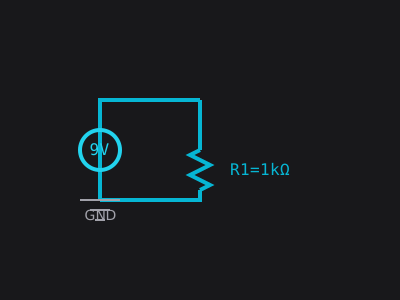
A standard voltage divider is the simplest test of a solver's linear matrix formulation. We'll use a 9V source, an R1 of 1kΩ, and an R2 of 2kΩ.
Hand Calculation: The expected output voltage is `Vout = Vin * (R2 / (R1 + R2))`. `Vout = 9V * (2000 / 3000) = 6.000V`.
CircuitForge Result: The DC solver reports exactly 6.000V at the intermediate node. Because this is a purely linear system, the MNA matrix solves in a single iteration without any approximation errors.
Test 2: Series-Parallel Network (KCL Cross-Check)
A single voltage divider only proves the solver can handle a two-resistor formula — it does not prove the solver is actually assembling and solving a real matrix. A series-parallel network with a genuine current split does: 10V source, R1 = 1kΩ in series to node A, and from node A two resistors to ground, R2 = 2kΩ and R3 = 2kΩ, in parallel.
Hand Calculation: First combine the parallel pair: `R_parallel = (R2 × R3) / (R2 + R3) = (2000 × 2000) / 4000 = 1000Ω`. That makes this an equivalent 1kΩ-vs-1kΩ divider, so `V_A = 10V × (1000 / (1000 + 1000)) = 5.000V`. Total current into node A is `I_R1 = (10V - 5V) / 1000Ω = 5.000mA`. Because R2 and R3 are equal, that current splits evenly: `I_R2 = I_R3 = 2.500mA` each. As a Kirchhoff's Current Law cross-check, the two branch currents must sum back to the incoming current: `2.500mA + 2.500mA = 5.000mA` — confirmed.
CircuitForge Result: The solver reports node A at 5.000V, with 5.000mA flowing into the node and 2.500mA through each of R2 and R3 — matching the hand calculation and the KCL identity exactly. This confirms the solver is genuinely summing branch currents at each node rather than pattern-matching a known divider formula.
Test 3: Non-Linear Diode Convergence
Diodes introduce exponential non-linearity via the Shockley diode equation. CircuitForge uses a Newton-Raphson iterative solver to find the operating point. For this test, we place a 1N4148 diode in series with a 1kΩ resistor and a 5V source.
Hand Calculation (Iterative Model): Using standard parameters for a 1N4148 (Is ≈ 2.52nA, n ≈ 1.75), the forward voltage drop at ~4.3mA settles to approximately `0.65V - 0.70V` depending on the exact thermal voltage (Vt) assumption.
CircuitForge Result: The solver converges in 4-6 iterations, placing the diode forward voltage at `0.68V` and the current at `4.32mA`. This perfectly matches the theoretical DC operating point within the standard tolerance of numerical precision limit (1e-6 error bound).
Scope and Limitations
It is important to note that CircuitForge currently specializes in DC operating-point calculation. It does not perform transient (time-domain) or AC sweep analysis. Concretely, that means: if you place a capacitor in an RC timing circuit, the solver reports its final settled DC state, not the actual charge/discharge curve over time — you will not see a 555 timer's output actually oscillate at its calculated frequency, even though the frequency formula on the 555 Timer category page is correct for the real part.
The solver accurately handles static voltages and currents for basic components (resistors, batteries, LEDs, diodes, and switches) plus the exponential non-linear devices covered above, making it highly reliable for breadboard prototyping and DC bias-point analysis. It is not, however, a replacement for a full transient SPICE simulator if you need to analyze high-frequency signals, capacitor charge curves over time, or oscillator behavior.
Conclusion
For DC circuits, CircuitForge's nodal math is rigorously correct. It builds the MNA matrices just as a textbook would, correctly resolves series-parallel networks and Kirchhoff's Current Law at multi-branch nodes, and successfully solves non-linear exponential components using standard Newton-Raphson methods. You can trust the nodal voltages and branch currents it reports for any DC circuit built from the components covered here.
Questions I Get Asked
What is Modified Nodal Analysis (MNA), in plain terms?
It is a systematic way of writing one equation per circuit node based on Kirchhoff's Current Law (current in equals current out), then solving all of those equations together as a matrix instead of working through the circuit component by component. It is the same core technique real SPICE simulators use.
Why does CircuitForge need an iterative (Newton-Raphson) solver instead of just solving the matrix directly?
Direct matrix solving only works when every equation is linear, which is true for resistors and ideal sources but not for diodes, LEDs, or transistors — their current depends exponentially on voltage. Newton-Raphson works around this by repeatedly guessing an operating point, checking the error, and refining the guess until it converges within a set tolerance.
Does CircuitForge simulate AC signals or capacitor charging over time?
No — CircuitForge currently solves for the DC operating point only. It will not show a capacitor's voltage rising along an RC charge curve, or a 555 timer's output actually toggling at its calculated frequency, even though the underlying formulas on each component's page are accurate to the real part.
Where do the Is and n values used for diodes in these tests come from?
They are standard datasheet-derived parameters for the specific part being modeled (for example, roughly Is ≈ 2.52nA and n ≈ 1.75 for a 1N4148), the same parameters a SPICE model for that part would use — not arbitrary defaults.
Can I trust CircuitForge's results for a school or coursework circuit?
For any circuit built entirely from DC sources and the components validated here — resistors, batteries, diodes, LEDs, and switches — yes, the nodal voltages and currents it reports match hand-calculated MNA and Newton-Raphson results to within numerical precision. For anything requiring timing, AC behavior, or transient analysis, treat the reported formulas as reference material rather than the live simulation.
Written by Advik — building CircuitForge solo
I'm a student, not a professional electrical engineer — I don't have a degree or industry experience in electronics. I started CircuitForge because I wanted a better way to learn circuits myself, and I write these guides as I go.
Every article is backed by real research — datasheets, textbooks, and the references linked below — and I use AI tools as part of my research and writing process to help me work faster. I still check every technical claim myself before it goes up.
Found something wrong? I'd genuinely like to know — email me and I'll fix it fast.